Reflection Summary
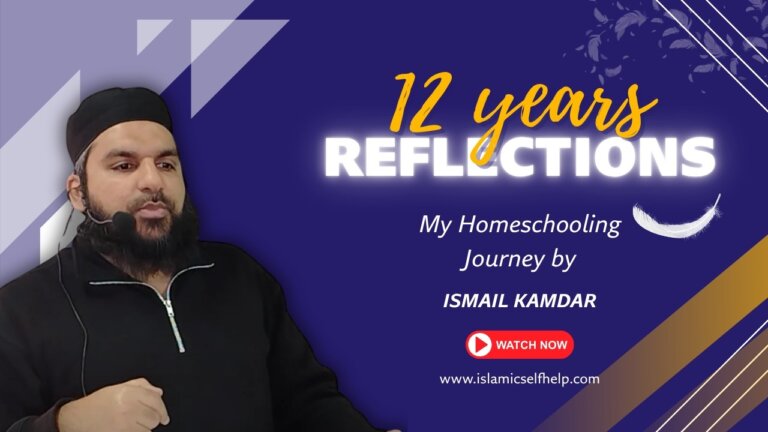
Shaykh Ismail Kamdar
It can be enriching, but it takes planning, and it depends on each family’s situation.
Research, consult, and plan; many early fears about re-entering school or college proved unfounded for his family.
Grandparents, community teachers, and other homeschooling families share the load and widen children’s world.
Go beyond the curriculum: first aid, money, cooking, problem-solving, and everyday tasks.
Little tech when young, more freedom with maturity, open spaces, and no personal phone until 16 in his home.
Start with adab, weave faith through every subject, and leave time for children’s own interests.
This is the final webinar in Shaykh Ismail Kamdar’s 2026 series on homeschooling. Having begun homeschooling his eldest child about twelve years ago, he now stands near the end of that journey, with his children one or two years from graduating, and shares what he has learned. He is openly pro-homeschooling, but he also stresses that it isn’t easy and isn’t right for every family or situation; the previous webinar in his series covered when not to homeschool.
His own story began with his education: he left school at 13 to study Islamic sciences full-time while finishing high school by correspondence, then earned a degree online. Years later, unhappy with the schools near him, he watched a webinar by a homeschooling mother, sought advice from a local homeschooling father, and agreed to try it for one year. That year became twelve. Through the pandemic, his family used online schools for difficult high school subjects, but eventually they all chose to return to their simpler original system: he teaches for two or three hours a day, and the children spend another two or three hours teaching themselves subjects they’re interested in. One became a professional video editor, another taught himself video game graphic design.
He then offers eight tips:
1. Take calculated risks. Many families choose the “safe” path of school, university, and a stable career, but that path isn’t the guarantee it once was. In his experience, risks taken after real preparation, consultation, and planning have paid off. Many early fears turned out to be unfounded: in his experience across several countries, schools were willing to take homeschooled children back into their age-appropriate grade after an entry assessment, and college admissions were more welcoming than he expected, since homeschoolers are often mature and self-disciplined. Rules differ by country, so parents should check locally.
2. Make it a team effort. No parent can teach every subject or be available all day without burning out. Involve grandparents, relatives, neighbors, the community, and other homeschooling families. His children have attended classes in other people’s homes for art, calligraphy, martial arts, and swimming. Homeschooling isn’t about isolating children with only their parents’ ideas; it’s about opening them to a wider community.
3. Don’t limit yourself to the school curriculum. He believes schools leave out much of what children need for life. Beyond the required subjects, he has taught his children deep thinking, problem-solving, financial literacy, entrepreneurship, first aid, cooking, cleaning, and family and relationship skills. He takes them along to handle real-world tasks like paperwork or passport applications so they can learn by watching.
4. Initiate social activities. The most common worry about homeschooling is socialization, and it’s a real risk if children are isolated. Parents are responsible for creating a social life: community sports, art classes, masjid youth programs. Homeschooled children can actually gain broader social skills because they learn to talk with people of all ages, not just their peers.
5. Adopt technology ethically and gradually. There’s no perfect answer, he says; this is the first generation of parents facing so much technology. His family’s approach: very limited technology when young, around two hours a day of gaming from about age five or six, more freedom as children mature, devices used in open areas where parents can see, tech-free family and prayer times, and no personal phone until 16. He warns that giving toddlers tablets full of short videos damages attention spans. The goal is for children to leave home able to use technology responsibly.
6. Prioritize Islam. Islam should be the lens through which children see everything, taught with balance rather than harshness. He starts with adab and character, following the principle of adab before knowledge, then gradually adds beliefs, worship, Quran, hadith, and history. Rather than treating Islamic studies as a lesser, separate subject, he weaves it into everything: the ethics of business alongside business studies, and what the Quran says alongside science.
7. Give children time and space to explore their interests. What children learn out of their own curiosity sticks better than what is imposed. Fill the home with books, board games, and sports equipment, get library cards, and let children develop real mastery. This is where a lifelong love of learning comes from. He values structure too, which is why he doesn’t fully “unschool,” but he sees this balance as powerful.
8. Don’t copy the school system at home. Children learn from books, videos, games, discussion, and above all by doing. Each child may take a different path; one may start a business at 15, another may aim for university. He notes that in many places adults can complete a high school qualification relatively quickly later on, so doors don’t close. Homeschooling, he says, teaches parents as much as children. It isn’t for everyone, but for those who can do it well, he believes it can be a deeply enriching and life-changing way to raise children with a love of learning and an Islamic worldview.
Shaykh Ismail tried homeschooling for one year, and it became twelve. He encourages parents to take calculated risks after research, consultation, and careful planning. In his experience across several countries, schools were open to taking children back into their age-appropriate grade, and colleges welcomed homeschoolers, though rules vary by country. He is clear that homeschooling is not easy and not right for every family.
If you’re considering homeschooling, research your local rules and talk with homeschooling families before deciding.
No single parent can teach everything or be available all day without burning out. Grandparents, relatives, neighbors, local experts, and other homeschooling families can each contribute, from calligraphy to martial arts. Done well, homeschooling widens a child’s world rather than isolating them, and parents are responsible for building a real social life through sports, classes, and masjid programs.
List the people in your family and community who could teach your child one skill, and reach out to one of them.
Beyond required subjects, he teaches deep thinking, problem-solving, financial literacy, entrepreneurship, first aid, cooking, and relationship skills. Children also spend a few hours a day pursuing their own interests; his have taught themselves video editing, graphic design, art, and calligraphy. Homes full of books, board games, and sports equipment, plus library cards, help children develop mastery and a love of learning.
Whether or not you homeschool, choose one real-life skill to teach your child this month, like first aid or budgeting.
He introduces technology gradually: little when very young, limited gaming from around five or six, more freedom as children mature, devices in open spaces, tech-free family and prayer times, and no personal phone until 16. He warns that short-form video on tablets harms young children’s attention spans. Islam should shape every subject rather than being a side subject: start with adab and character, then weave faith into science, business, and history, with balance rather than harshness.
Look at one subject your child is learning and find a way to connect it to an Islamic perspective together.
Keep books, board games, art supplies, and sports equipment within reach, and get your child a library card.
Give your child a regular block of time to learn something they choose, with resources available.
Pick something schools rarely teach, such as first aid, cooking, or managing money, and teach it hands-on.
Take your child with you to handle real-world tasks like paperwork or appointments, and explain what you’re doing.
Find a community class, sports team, or masjid program where your child can learn from and socialize with others.
There are no right or wrong answers here, just space to think about your own family.
What are my main hopes and worries about my child’s education?
Am I choosing our education path out of conviction, or mainly because it’s what everyone else does?
Who in our family or community could help teach my child?
What real-life skills does my child need that school isn’t teaching?
Does my child have time to explore their own interests each week?
Every family is different. If you’ve tried something that made a difference in your family, we’d love to hear about it.
More reflections that may help you think about this from another angle.