Reflection Summary
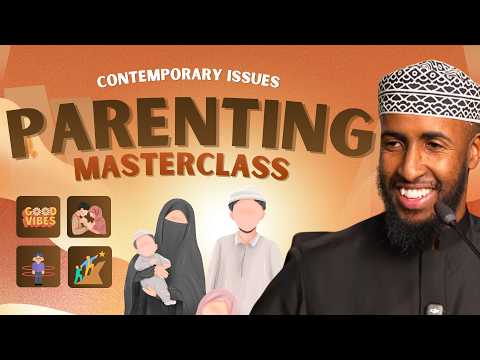
Sheikh Ali Hammuda
Sheikh Ali suggests the stages to which the texts attach numbers: up to two, the period of breastfeeding; two to seven; seven to ten; ten to puberty; and puberty, when accountability begins. He asked the audience to propose their own stages first.
He says young children learn mainly by watching and imitating, so the best way to teach is to model. He reads the hadith about instructing children to pray at seven as meaning that parents should show prayer before then rather than command it.
He says children pick up their parents’ fears, such as a shriek at a spider, and that such fears can be very difficult to undo. He encourages parents to manage their own reactions and to let children see affection between their parents.
He calls this a short, narrow window in which children receive instruction more easily. He urges parents to immerse them in honorable skills and experiences, including through relatives and teachers who can offer what the parents cannot.
He says parents should extend trust, giving older children duties that matter and linking privileges to responsibility. He points to the Prophet’s ﷺ practice of entrusting young people with significant tasks.
He says earlier guidance is always more effective, but that it is never too late to begin. He describes modeling as the most effective way of nurturing children, citing Albert Schweitzer’s remark that it is the only way.
Sheikh Ali Hammuda opens the last session of his series “Our Ways” by saying that the more he studies the raising of children, the more he feels he has not done the topic justice. He asks the audience to propose their own age brackets and the defining feature of each, then offers the stages he says Islamic texts attach numbers to. Up to two is the period of breastfeeding named in the Quran. From two to seven is the stage that leads up to the hadith about instructing children to pray at seven. Seven to ten follows, and at ten, he says, the Prophet ﷺ raised the emphasis on prayer. Then comes puberty, when a person becomes accountable before Allah. He also mentions that the Quran names the age of forty as a point of full maturity.
For the years before seven, he says the defining feature is observation. Children watch, copy and imitate, so the best way to teach them is to model what you hope they will become. He says a classroom of pen and paper suits this age poorly, and he points to Finnish schools, which he describes as delaying formal academics until seven and providing space to play, socialize and learn by listening and watching in the meantime. As one idea, he suggests playing the portion of Quran you hope a child will learn in the background while they play. He says the most important thing for children to see is how their parents treat each other, with affection and respect, and how much they value prayer, for example by stopping to pray while traveling or out for a meal. He reads the hadith about instructing children at seven as implying that parents should not command prayer before then but let children come to love it by watching, and he mentions a father of many sons who pray at the masjid who gave him the same advice.
He also warns about what young children should not absorb, especially fear. He says fears children pick up by watching their parents can be very difficult to undo. He gives everyday examples, such as a parent shrieking at a spider or a mouse, or showing fear of dogs or of the dark, and says he tries to manage his own reactions so as not to pass on his parents’ fears. He adds that telling a young child to wait until Dad comes home may give the child an image of a father as a monster. Fathers do have a role in teaching and discipline, he says, but the point is not to terrify.
From seven to ten, Sheikh Ali says, a child can receive instruction in ways that were not possible before, and the defining feature is skills. He calls it a short, narrow window in which the soil receives whatever is planted, before the stubbornness and search for independence that come as puberty nears and before school and coursework crowd the calendar. He urges parents to immerse children in every honorable skill and experience available, such as managing money and time, literacy, social skills, technology, public speaking and drama, and to bring in relatives, teachers and tradespeople who can offer what the parents cannot. Love and care continue throughout, he says, but the priority at this stage is skills.
From ten to puberty, he says, the defining feature is duty and responsibility. Puberty is the greatest transformation a person goes through, and the point at which Allah holds a person accountable, so parents should extend trust by giving children duties and a sense of contributing to something bigger. Children at this age want to be treated as adults, he says, which is natural and should be guided: they can have privileges, but privileges come with responsibility, otherwise a sense of entitlement may follow. He notes that the Sunnah has little verbal guidance on this age and suggests that the Prophet ﷺ dealt with it practically, by entrusting young people with significant tasks, and he recalls the Prophet’s ﷺ gentle response to a young man struggling with desire. He suggests that some temptations teenagers fall into come from seeking validation elsewhere, and that a trusted, meaningful task leaves less room for them. He closes with two reminders. The earlier a parent steps in, the better, but it is never too late. And modeling is the most effective way of nurturing excellence. He cites Albert Schweitzer’s remark that it is not the best way but the only way, gives examples of mismatches children notice, such as asking a child to say you are not home, constant talk of money and investments, or smoking in front of them, and points to Abdullah ibn Umar, who narrated many reports praising his father, as a child shaped by seeing a parent’s character. He ends by saying that children learn what faith means from seeing parents make dua, pray attentively and give.
Sheikh Ali suggests the stages to which Islamic texts attach numbers: up to two, two to seven, seven to ten, ten to puberty, and puberty. He gives each a defining feature: observation before seven, skills from seven to ten, and duty and responsibility from ten to puberty. He says love and care continue at every stage, and that guidance should adapt to what a child can receive at that point. He says earlier guidance is always more effective, but that it is never too late to begin.
Think about which stage your child is in and what they may need most from you right now.
Sheikh Ali says young children learn mainly by watching, so what parents do carries more weight than what they say. He says children pick up parents’ fears and reactions, and that affection between parents and attention to prayer are among the most valuable things for them to see. He cites Albert Schweitzer’s remark that modeling is not the best way to raise effective people but the only way, and gives examples of the mismatch children notice between words and behavior. He points to Abdullah ibn Umar as a child shaped by seeing his father’s standing and character.
Notice what your children may be learning from how you react, not only from what you say.
Sheikh Ali calls ages seven to ten a short window to immerse children in skills and experiences, including through relatives and teachers who can offer what parents cannot. From ten to puberty, he says, parents should extend trust, giving children duties that matter to others. He says children asking to be treated as adults can have privileges, but privileges should be tied to responsibility. He suggests that a meaningful task, as the Prophet ﷺ entrusted to young people, leaves less room for the temptations of seeking validation elsewhere.
Look for one real task your child could be trusted with that matters to someone else.
Let young children see you pray and value it, such as stopping to pray while out, rather than only telling them to. Sheikh Ali reads the hadith about seven as meaning to show first and instruct later.
The next time you feel afraid or disgusted in front of your child, such as at a spider, notice your reaction and try to stay calm. Sheikh Ali says children absorb parents’ fears.
Choose one skill or experience for a child between seven and ten, such as handling money, public speaking, or learning a craft from a relative, and make time for it. For parents applying this idea, make sure any hands-on experience with a tradesperson or workplace is supervised and suitable for your child’s age.
Give an older child a duty that matters to the family and explain why it matters. Sheikh Ali says privileges should come with responsibility.
Let your children see you raise your hands in dua and pray with attention. Sheikh Ali says children learn what faith means from seeing it in a parent.
There are no right or wrong answers here, just space to think about your own family.
What stage is my child in, and what do they most need from me right now?
What reactions or habits of mine might my children be picking up, and what helps me stay steady?
What skills or experiences could the people around us offer my child that I cannot?
Where could I trust my child with something that truly matters, and what would I need to let go of to do it?
What might my children say they have learned from watching me about what matters most?
Every family is different. If you’ve tried something that made a difference in your family, we’d love to hear about it.
More reflections that may help you think about this from another angle.