Reflection Summary
ParentingTrix
The video cautions that repeatedly comparing siblings may create shame or jealousy rather than the motivation a parent intends.
There is a real difference between you made a mistake and you are a mistake.
The video cautions that repeatedly telling children to stop crying may teach them to hide feelings rather than learn how to express and manage them.
Saying you’re fine when they’re not can quietly close the door on future openness.
Framing correction as I don’t approve, but we’ll work through this together preserves connection while still holding a boundary.
Even said in frustration, hopeless predictions are remembered for years and can quietly shape what a child expects of themselves.
This video identifies eight common phrases parents say, often in ordinary frustration, that can quietly shape a child’s confidence and emotional health for years. The first is comparison, why can’t you be more like your brother, illustrated through a gardener who plants both a rose and a bamboo seed, then grows frustrated when the bamboo appears to do nothing, not realizing it spends years building deep roots before it grows rapidly. Children develop at different speeds in different directions, and the video cautions that comparison may create shame rather than motivation. The second is permanent labeling, you always mess everything up, which teaches a child to internalize temporary behavior as identity. There’s a real difference between saying you made a mistake and you are a mistake, one teaches responsibility, the other creates shame.
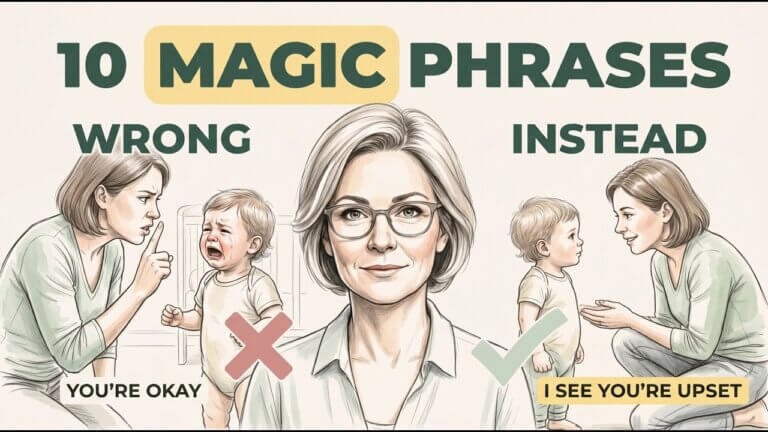
Two phrases concern how feelings get handled. The video cautions that stop crying, especially common with boys, may teach a child to hide what they feel rather than learn how to express and manage it. You’re fine, said when a child is genuinely scared or hurt, teaches them their feelings don’t matter, and some children eventually stop opening up because they expect not to be understood. In both cases, the suggested alternative is simple validation, acknowledging the feeling without exaggerating the problem, something like that was difficult, wasn’t it, rather than dismissing it outright.
Several phrases concern discipline and authority. The video cautions that some children may hear harsh expressions of parental disappointment as a judgment of their worth rather than their behavior. Because I said so, used as a default, limits a child’s ability to develop internal reasoning and self-control. The video encourages parents to explain the reasons behind rules when circumstances allow, while acknowledging that immediate compliance is sometimes necessary for safety. In both cases, the suggested shift is pairing correction with reassurance and explanation where possible, I don’t approve of what happened, but we’ll work through this together, preserving connection while still holding a boundary.
The final two phrases involve underlying causes and hope. You’re so lazy labels a child instead of asking what’s actually underneath low motivation, discouragement, overwhelm, exhaustion, illustrated by the image of criticizing someone for walking slowly while ignoring the heavy backpack they’re carrying. And the video warns that repeated hopeless predictions, like you’ll never succeed, even said in a moment of anger, may shape how a child sees their own potential and willingness to keep trying, since children tend to remember painful predictions for years. The suggested alternative pairs honest correction with continued belief, your choices need to change, but I know you’re capable of better. The video closes by noting that a parent’s repeated words gradually become a child’s own inner voice, and that wise parenting isn’t about never slipping up, but becoming more intentional with language over time.
The video cautions that comparing a child to a sibling, why can’t you be more like your brother, may create shame and jealousy rather than the motivation a parent intends. Children develop at different speeds and in different directions, some bloom early, others take longer to show their strengths. Labeling behavior as identity, you always mess everything up, teaches a child to internalize temporary mistakes as permanent truths about themselves. There is a real difference between saying you made a mistake and you are a mistake, one teaches responsibility, the other creates shame. Replacing both with specific encouragement, I believe in your progress, builds identity instead of insecurity.
Next time you’re tempted to compare your child to a sibling, try naming their own specific progress instead.
The video cautions that stop crying may teach a child to hide feelings rather than learn how to express and manage them. You’re fine, said to a genuinely upset child, teaches them their feelings don’t matter, and some children eventually stop opening up. The video recommends simple validation, acknowledging a feeling without exaggerating the problem, over either suppression or dismissal. The video says children who feel emotionally safe tend to develop stronger coping skills and greater confidence over time.
If your child is upset, try saying I see you’re upset, let’s talk when you’re calmer, instead of stop crying or you’re fine.
You’re so lazy labels a child instead of asking what’s actually underneath low motivation, discouragement, overwhelm, or exhaustion. The video warns that repeated hopeless predictions, like you’ll never succeed, even said in anger, may shape how a child sees their own potential and willingness to keep trying. Pairing honest correction with continued belief, your choices need to change, but I know you’re capable of better, preserves both accountability and hope.
Next time discipline is needed, pair the correction with reassurance: I don’t approve of this, but we’ll work through it together.
Next time you’re tempted to compare your child to a sibling, name their own specific progress instead.
If your child is upset, try I see you’re upset, let’s talk when you’re calmer, instead of stop crying or you’re fine.
Next time discipline is needed, try I don’t approve of this, but we’ll work through it together.
If your child seems unmotivated, ask what might really be underneath it before labeling them lazy.
There are no right or wrong answers here, just space to think about your own family.
Which of these eight phrases, if any, do you catch yourself saying most often?
How do you currently respond when your child is upset, do you validate the feeling or try to minimize it?
Does discipline in your home tend to threaten connection, or does it stay paired with reassurance?
What’s one phrase from this list you’d like to consciously replace this week, and what will you say instead?
Every family is different. If you’ve tried something that made a difference in your family, we’d love to hear about it.
More reflections that may help you think about this from another angle.