Reflection Summary
Parenting Hacks
Instead of immediately supplying an answer or instruction, the video encourages parents to ask questions that require a child to plan, reason, and explain their thinking.
Rescuing a child too quickly can prevent the productive struggle that actually builds reasoning ability.
Asking what did you learn rather than why did you do that shifts a child from defensiveness to analysis.
Verbalizing your own decision-making, including uncertainty, teaches more than any instruction to think it through.
Offering two options instead of one directive requires a child to actually evaluate and decide.
The video encourages parents to invite children to explain opinions they disagree with, giving them practice articulating and defending their reasoning respectfully.
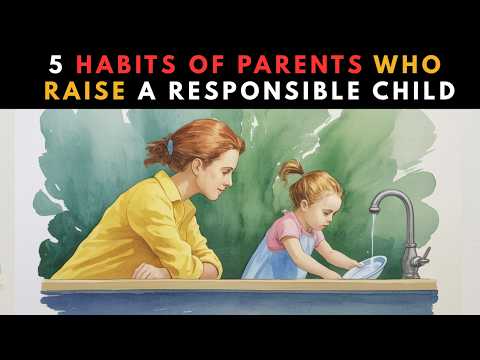
This video opens with a reframe worth sitting with: the real long-term risk isn’t a child who disobeys, it’s a child who never learned how to think without a parent present. Since every child will eventually face situations with no parent, teacher, or guide nearby, the real question becomes whether a child has been raised to listen or raised to think. The first habit is asking more questions than giving answers, instead of do your homework now, asking what’s your plan for finishing it today, which the video encourages as a way to give a child practice planning, reasoning, and explaining their thinking rather than simply issuing an instruction. The second is allowing safe struggle rather than rescuing too quickly, responding to I can’t do it with show me what you’ve tried so far, and the video suggests allowing a brief period of manageable struggle before stepping in, while remaining available to guide rather than take over.
The third and fourth habits involve mistakes and modeling. The video recommends treating mistakes as opportunities for reflection by asking what worked, what didn’t, and what the child might try next, rather than why did you do that, shifting a child from a defensive, fearful response toward genuine reflection. Modeling thinking out loud, verbalizing a decision process including uncertainty, I’m choosing this because I’m considering two options, I might be wrong, shows a child that thinking is an ongoing process rather than something that simply appears fully formed.
The fifth and sixth habits center on responsibility and independent reasoning. Offering choices instead of commands, would you like to read now or in ten minutes, requires a child to actually evaluate options and take responsibility for a decision, described as building internal leadership over time. The video encourages parents to invite children to explain opinions they disagree with, giving them practice articulating and defending their reasoning respectfully, correcting gently without ever silencing the disagreement itself.
The seventh habit, prioritizing real conversation over simple instruction, treats ordinary moments, dinner, car rides, bedtime, as genuine opportunities for dialogue rather than just logistics, asking things like what was the most interesting thing you learned today or what confused you. The video closes by returning to its central point: the actual goal isn’t raising a child who always needs a parent nearby to function, it’s raising one who can ask questions, solve problems, and reason independently once no guide is present at all.
Asking questions instead of giving answers, what’s your plan for finishing this, gives a child practice planning, reasoning, and explaining their thinking rather than simply issuing an instruction. Allowing safe struggle means responding to I can’t do it with show me what you’ve tried so far, rather than stepping in immediately. The video suggests allowing a brief period of manageable struggle before stepping in, while remaining available to guide rather than take over. Both habits shift a parent’s default response away from providing immediate solutions and toward building a child’s own capacity. This requires real patience, especially when it would be faster to simply answer or fix the problem directly.
Today, try turning one instruction into a question: instead of do your homework now, ask what is your plan for finishing your homework.
Turning mistakes into thinking opportunities means asking what did you learn from this rather than why did you do that. The video recommends treating mistakes as opportunities for reflection by asking what worked, what didn’t, and what the child might try next, rather than framing them primarily around punishment. Modeling thinking out loud, verbalizing a decision process including uncertainty, shows a child that thinking is an ongoing process, not something that simply appears fully formed. Saying I might be wrong, but here’s what I think demonstrates that uncertainty is a normal part of reasoning, not something to hide. Children learn this mainly through observation, not through being told to think more carefully.
After a mistake, ask what did you learn instead of why did you do that.
Offering choices instead of commands, would you like to read now or in ten minutes, requires a child to evaluate options and take responsibility for a decision. This is described as building internal leadership over time, rather than simple compliance. The video encourages parents to invite children to explain opinions they disagree with, giving them practice articulating and defending their reasoning respectfully. Prioritizing real conversation over simple instruction treats everyday moments, dinner, car rides, bedtime, as genuine opportunities for dialogue. The underlying goal across all of these is a child who can reason and stand on their own once no guide is present.
Turn one command into a choice today, even something small like when to read or what to eat first.
Today, try instead of do your homework now, ask what’s your plan for finishing your homework.
Next time your child says I can’t do it, ask what have you tried so far instead of stepping in immediately.
After a mistake, ask what did you learn instead of why did you do that.
Turn one command into a choice today, even something small like when to read or what to eat first.
There are no right or wrong answers here, just space to think about your own family.
How often do you find yourself giving answers versus asking questions when your child faces a problem?
Where do you tend to rescue your child too quickly instead of letting them struggle briefly first?
How comfortable are you when your child disagrees with you? Do you shut it down or ask them to explain their reasoning?
What would one genuine, phone-free conversation with your child look like tonight?
Every family is different. If you’ve tried something that made a difference in your family, we’d love to hear about it.
More reflections that may help you think about this from another angle.