Reflection Summary
QuranGuy
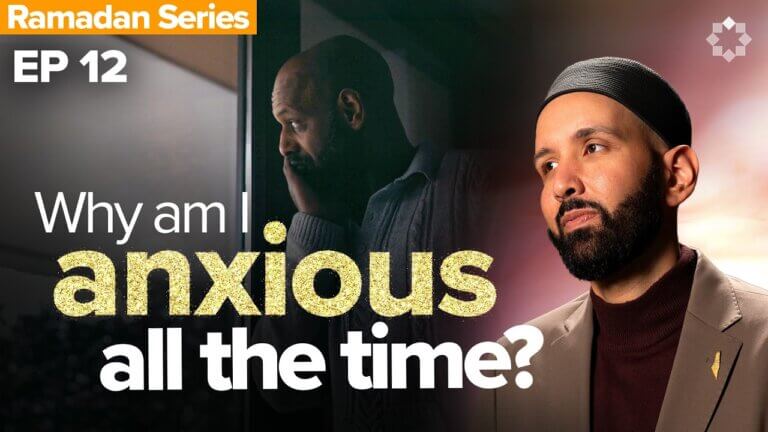
He argues that anxiety can intensify when a person begins treating an uncertain outcome as something they must personally secure.
The speaker uses qadar to distinguish between a person’s responsibility for effort, intention and choices and Allah’s ultimate control over outcomes.
Refusing to act and calling it trust in Allah is described as fear wearing a spiritual costume, not reliance at all.
The example given is Maryam being told to shake a palm tree even though her provision was already guaranteed.
Ibrahim’s and Musa’s declarations of trust came before any visible resolution, described as the actual location of tawakkul.
The video points to a Prophetic narration describing sincere dua in three possible ways: the request may be granted, a harm may be averted, or its reward may be stored for the Hereafter.
This talk connects anxiety with a quiet, unexamined belief, specifically the belief that an outcome’s arrival depends on you. The speaker tests this by pointing out what we’re never anxious about, whether the sun will rise, whether gravity will hold, precisely because those things were never assigned to us in the first place. Qadar, Allah’s divine decree, is presented as the practical line this draws: effort, intention, and choice are fully a person’s own responsibility, while the result, what actually lands or opens, was never theirs, not for a single day.
He distinguishes genuine reliance from what he describes as its passive imitation, illustrated through two contrasting people. One avoids acting entirely and calls the avoidance trust in Allah, which he frames as fear wearing a spiritual costume rather than real reliance. The other does everything, executes every plan and backup, and then lies awake auditing all of it. Both, in his framing, are still privately holding onto the outcome rather than actually releasing it. He notes that trust without taking real, concrete means has been described by scholars as a defect rather than a higher spiritual state, illustrated by the well-known instruction to tie your camel and then trust in Allah, both together, not one instead of the other.
The deeper distinction he draws is that tawakkul isn’t a technique for negotiating a specific desired outcome from Allah, but certainty that Allah’s choice is better before knowing what that choice will be. He lays out four components he argues must work together: genuinely knowing Allah through His names and attributes, since weak trust is often really just weak knowledge of who you’re trusting; taking the means completely as an act of worship, an idea he illustrates through Maryam’s instruction to shake the palm tree as an example of taking the available means while recognizing that the ultimate result comes from Allah; consciously handing the outcome over, described as a repeated practice rather than a single event; and contentment with whatever comes back, which he describes as the fruit of the first three rather than a starting point.
Drawing on his own experience, he says that repeatedly auditing uncertain outcomes consumed attention and energy he could otherwise devote to the work in front of him. He’s honest that letting go of that doesn’t always look like quick success: he shares his own account of reaching a long-standing goal faster than expected once he stopped auditing outcomes, while also admitting that two things he worked hardest for never opened at all, and something entirely unplanned changed everything instead. He addresses those carrying long-unanswered prayers directly, pointing to a Prophetic narration describing sincere dua in three possible ways: the request may be granted, a harm may be averted, or its reward may be stored for the Hereafter. He closes with a brief nightly practice: naming the one outcome being carried, naming what’s actually within reach the next day, and consciously handing the rest over, returning to that same practice each time the worry resurfaces.
The speaker connects anxiety with a quiet belief that the outcome depends on me. We are never anxious about things fully outside our control, like whether the sun will rise, because those were never assigned to us. The speaker uses qadar to distinguish between a person’s responsibility for effort and choice and Allah’s ultimate control over the outcome. A heart trying to guard an outcome cannot rest, since outcomes live in a future the heart has no access to. Recognizing this as a job description error, rather than a personal failing, is presented as the starting point for change.
Name out loud what part of a worry is actually within your control and what part never was.
One passive version of trust looks like refusing to act at all and calling the avoidance faith, described as fear wearing a spiritual costume. Another version looks like doing everything, then lying awake auditing all of it, still privately holding the outcome. Trust without taking real, concrete means has been described as a defect rather than a higher spiritual state. The speaker interprets Maryam’s instruction to shake the palm tree as an illustration of taking the available means while recognizing that the ultimate result comes from Allah. Genuine tawakkul requires taking action fully, not skipping it in the name of trust.
Notice if your own planning or checking has become a way of quietly holding onto an outcome rather than releasing it.
Tawakkul is described as certainty that Allah’s choice is better before knowing what that choice will be, not a technique for negotiating a desired outcome. The speaker points to a Prophetic narration describing sincere dua in three possible ways: the request may be granted, a harm may be averted, or its reward may be stored for the Hereafter. A personal account describes reaching a long-standing goal faster than expected once outcomes stopped being audited, while two heavily pursued goals never opened at all. Something entirely unplanned changed everything instead, illustrating that the outcome may look nothing like what was originally hoped for. A brief nightly practice, naming what’s being carried, naming what’s within reach tomorrow, and handing the rest over, is offered as the practical starting point.
If a long-standing prayer for your family remains unanswered, remember that is not the same as being ignored.
Next time you’re anxious about something involving your child, name out loud what part is within your control and what isn’t.
Notice if your own planning or checking has become a way of quietly holding onto an outcome rather than genuinely releasing it.
Before acting on something for your family, remind yourself: the effort is yours, the outcome was never yours to guarantee.
If a long-standing dua for your child or family remains unanswered, remember it is not the same as ignored.
There are no right or wrong answers here, just space to think about your own family.
What outcome involving your children are you currently trying hardest to control or guarantee?
Do you tend toward avoidance disguised as trust, or constant planning disguised as responsibility, when you are anxious about your family?
What would it look like to take full, excellent action for your children while genuinely releasing the result?
Is there a long-unanswered prayer for your family that this reframing changes how you think about?
Every family is different. If you’ve tried something that made a difference in your family, we’d love to hear about it.
More reflections that may help you think about this from another angle.