
Reflection Summary
Dr. Omar Suleiman
A hadith describes fear and security as mutually exclusive when directed at Allah, reverence now is linked to safety later, false confidence now to fear later.
This name is tied to inner tranquility and faith; Dr. Suleiman illustrates it through Hajar’s inward assurance, which he reads as arriving before her outward rescue.
Described as the overseeing protector, active even when unseen; Dr. Suleiman illustrates it through the events before and during the Battle of Badr.
Illustrated through Yaqub’s story: Dr. Suleiman reflects that Allah’s preservation was not limited to the missing son, seeing Yaqub’s sustained faith through years of separation as another form of preservation.
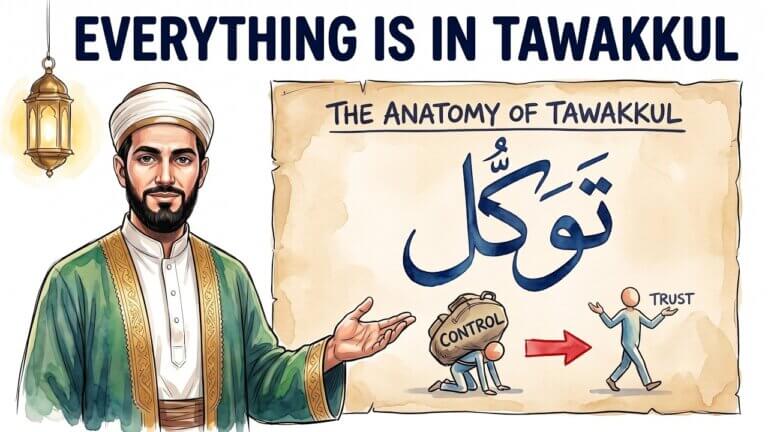
Trusting Allah doesn’t mean stepping back from effort, it means handing over the outcome once genuine effort has been made.
Allah is sufficient for me is shown appearing at real moments of crisis throughout Islamic history, said precisely when things felt most uncertain.
Dr. Omar Suleiman opens with a hadith describing fear and safety as mutually exclusive when both are directed at Allah, reverence now is linked to safety on the Day of Judgment, while false confidence now is linked to fear later. From this, he introduces the first of four names as a door of protection: Al-Mu’min, tied to the same root as faith itself, securing a person’s heart from the inside. He illustrates this through Hajar, stranded in the desert with a dying child. Dr. Suleiman reflects on her experience as an example of inward assurance preceding the outward means of relief represented by Zamzam.
The second name, Al-Muhaymin, moves from inner security to surrounding watchfulness, an ever-present oversight that catches what a person cannot see coming. Dr. Suleiman uses the events surrounding Badr to illustrate how he understands Al-Mu’min and Al-Muhaymin working together: rain sent for physical purification, reinforcement sent from the unseen, hearts steadied before the fighting even began — framing this name as especially meaningful for anyone who feels powerless against people or circumstances larger than themselves.
The third name, Al-Hafidh, the preserver, is illustrated through the story of Yaqub, who lost one son and feared losing a second, yet maintained that Allah remained the best of preservers even amid what looked like total loss. Dr. Suleiman reflects that Allah’s preservation in the story was not limited to Yusuf; he sees Yaqub’s sustained faith through years of separation as another form of preservation. He describes acts such as charity, fasting, and engagement with the Quran as means through which Allah grants protection, and connects this same preservation to difficult stories themselves, kept intact so they can still be read and learned from long after.
The final name, Al-Wakil, is where trust becomes active delegation rather than passive waiting. Dr. Suleiman traces a specific phrase, Allah is sufficient for me, appearing at genuine moments of crisis throughout Islamic history, Ibrahim facing a fire, the Prophet and his companions facing a surrounding army, Aisha enduring a period of slander, each said precisely when the situation felt most uncertain, not as a comfortable saying but as a real declaration of trust. His closing point is that trusting Allah was never about stepping back from effort, it means recognizing Allah as the actual force behind outcomes while genuine effort continues alongside that trust, the four names working together as a kind of layered progression from inner peace, to outer protection, to preservation, to active surrender.
Al-Mu’min secures a person’s heart from the inside, tied to the same root as faith itself. Dr. Suleiman reflects on Hajar’s story as an example of this: inward assurance that Allah would never abandon her, arriving, in his reading, before the outward miracle of water. Al-Muhaymin moves from inner security to surrounding watchfulness, an ever-present oversight that catches what a person cannot see coming. Dr. Suleiman uses the events before and during the Battle of Badr, rain, reinforcement, steadied hearts, to illustrate how he understands both names working together. This name is described as especially meaningful for anyone who feels powerless against people or circumstances larger than themselves.
Next time you feel afraid about something involving your family, notice whether that fear is really about something you’ve quietly assigned to yourself to control.
Yaqub lost one son and feared losing a second, yet maintained that Allah remained the best of preservers even amid what looked like total loss. Dr. Suleiman reflects that Allah’s preservation was not limited to the missing son; he sees Yaqub’s sustained faith, mind, and heart through two decades of grief as another form of preservation. Dr. Suleiman describes acts such as charity, fasting, and engagement with the Quran as means through which Allah grants protection. This same preservation extends to difficult stories themselves, kept intact so they can still be read and learned from long after. Preservation, in this framing, is about continuity of care, not simply a shield from harm.
Reflect on Yaqub’s story next time you’re worried about a child’s wellbeing or future, and what it means that Allah was preserving his heart the whole time.
A specific phrase, Allah is sufficient for me, appears at genuine moments of crisis throughout Islamic history, Ibrahim facing a fire, the Prophet facing a surrounding army, Aisha enduring slander. Each was said precisely when the situation felt most uncertain, not as a comfortable saying but as a real declaration of trust. Trusting Allah was never about stepping back from effort, it means recognizing Allah as the actual force behind outcomes. Genuine effort continues alongside that trust, rather than being replaced by it. The four names work together as a layered progression, from inner peace, to outer protection, to preservation, to active surrender.
Practice saying Allah is sufficient for me not as a comfortable phrase, but specifically in a real moment of uncertainty this week.
Next time you feel afraid about something involving your family, notice whether that fear is really about something you’ve quietly assigned to yourself to control.
Reflect on Yaqub’s story next time you’re worried about a child’s wellbeing or future.
Say Allah is sufficient for me specifically during a real moment of uncertainty this week, not just as a comfortable saying.
Notice where you’ve already done your genuine effort in a situation, and consciously hand the rest over rather than continuing to grip it.
There are no right or wrong answers here, just space to think about your own family.
What fear are you currently carrying about your family or your children that you could bring to mind through these four names?
How does Yaqub’s story change the way you think about a long season of worry over someone you love?
Where in your life could you separate doing your part from controlling the outcome more clearly?
What would it look like to say Allah is sufficient for me as a real practice this week, rather than just a phrase?
Every family is different. If you’ve tried something that made a difference in your family, we’d love to hear about it.
More reflections that may help you think about this from another angle.

Sheikh Belal Assaad
QuranGuy
Ustadha Sarah Sultan
Dr. Rania Awaad, M.D.